A Formula 1 car reaches more than 300 kilometers per hour multiple times during a race. How do they not lift off the asphalt? Because of aerodynamics and the complex design of the car that prevents that from happening. Aerodynamics is the branch of fluid mechanics that studies the actions and forces exerted on solid bodies when there is relative movement between them and the air. In Formula 1, aerodynamics focuses on the design of the single-seaters to take advantage of airflow and optimize the movement of the car. Aerodynamics is divided into five branches that achieve this objective: downforce, drag aerodynamics, airflow management, ground effect, and cooling aerodynamics.
Downforce
Downforce aims to stick the car to the ground without making it heavier. Downforce is the vertical force that pushes the car against the asphalt. It is not the same as weight, because weight is a force generated by the mass of the car and gravity. Instead, downforce is a vertical force generated by the redistribution of air over the bodywork; this pushes the single-seater downward without increasing mass. This is achieved thanks to the different parts of the car, mainly the front and rear wings.
Bernoulli’s principle establishes that, in a fluid under circulation, the energy it possesses remains constant throughout its path; therefore, if the speed of the air increases, pressure decreases simultaneously and vice versa. This is precisely what happens with the wings. The air is interrupted by the wing, splitting it and causing different speeds and pressures. This causes the air to push the car downward. Bernoulli’s equation relates pressure, velocity, and the energy of a moving fluid. Bernoulli’s equation is P+1/2ρv²+pgh=Constant. “P” is air pressure; “1/2ρv²” is the energy of the air’s movement (kinetic energy, where ρ is air density and v is velocity); “pgh” is the potential energy due to height.
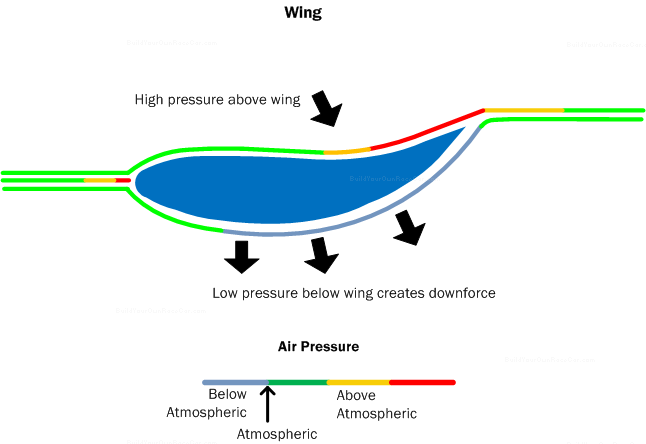
Airflow and generation of downforce in a Formula 1 single-seater.
Source: Xingal Engineering (2017).
This is crucial for the car because if the car has a vertical force pushing it toward the asphalt, multiple aspects of the car benefit. The force pushing the car downward allows it to take corners at higher speeds, since the tires always remain in contact with the surface, providing greater grip. The tires do not slide, which keeps the handling of the car stable and eliminates the possibility of sliding. The wings change angle depending on the circuit to provide more or less downforce. In a circuit with high-speed corners and many straights, very little wing angle is needed. At the Autodromo Nazionale di Monza, a lot of top speed is needed, since all the corners are medium or high speed; therefore, the wings are adjusted to an angle of 5 to 15 degrees (depending on the specifications of the car and the tire). On the other hand, in a circuit with many low-speed corners and few straights, more angle is needed. At the Circuit de Monaco, a lot of downforce is needed, since there are sharp-angle corners; therefore, the wings are modified to reach angles of 25 to 40 degrees or more.
Drag Aerodynamics
Drag aerodynamics aims to reduce resistance to movement. The air slows the car down. If the wing is tilted at a greater angle, more drag is generated, which allows corners to be taken in a more stable and faster way, but reduces top speed. If it is placed at a smaller angle, drag is reduced and greater top speed is achieved, but the car may become more unstable and slower in corners. This represents a challenge for engineers looking for a middle point that offers the highest top speed and the greatest stability in corners.
Drag happens when the car has to cut through the air, since the air interrupts its movement. Air, having mass and density, needs to be passed through, and energy is needed to cut through it. The drag equation measures the drag force experienced by an object moving through a fluid. The equation is Fd=1/2CdρAv². “Fd” is the aerodynamic drag force. “Cd” is the drag coefficient: a higher Cd indicates more resistance; a lower Cd, less resistance. “ρ” is air density. “A” is the frontal area of the car, the first part that comes into contact with the air; a larger area means more resistance, and a smaller area, less resistance. “V” is the speed of the car.
Airflow Management
Airflow management aims to control the direction of the air. The car not only cuts through the wind, but also redistributes it. Air is redistributed to different areas of the single-seater for use in various applications. The main areas where air is redistributed are the floor, the radiators, the brakes, among others. Under ideal conditions, all systems maintain the same airflow at all times, but in a race this is not the case. If one car is ahead and another is chasing it, the car in front is cutting through the air, making two things happen: first, turbulence due to the air not being completely consistent, leading to understeer (when the car does not rotate enough to take the corner) or oversteer (when the car rotates too much while taking a corner). Second, because the car is using air to keep its systems at an optimal temperature, the air heats up. This phenomenon is known as dirty air. Dirty air can be beneficial in certain situations. When a car is chasing another on a straight, the car reaches a higher top speed because one variable of force (air) slowing the car down is removed. However, in a corner where you need the air to slow the car down and help it take the corner consistently, inconsistent air makes the car harder to predict.
It is easier to cut through the air if there is less initial contact area; that is why the point of contact on the front wing is very small and then gradually increases. However, the air travels following the silhouette of the car; this is known as the Coandă effect, according to which a fluid tends to stick to and follow the contour of a nearby curved surface instead of bouncing off or following a straight-line path.
Ground Effect
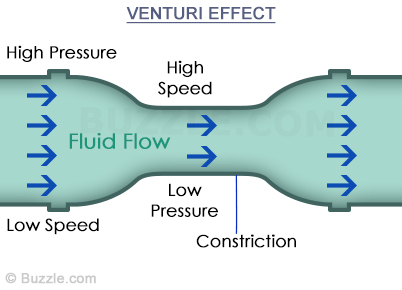
Ground effect aims to generate downforce underneath the car. The single-seater is designed so that air circulates underneath it, through specific sections, producing a Venturi effect in the car. Air passes through narrower sections called Venturi tunnels. Venturi tunnels are wide at the entrance so clean air can enter. In the central part (called the throat), the tunnel becomes narrower; therefore, the air moves at a higher speed and, at the same time, pressure decreases, which pushes the car downward. This happens because of Bernoulli’s principle, which states that when the speed of a fluid increases, pressure decreases inversely and vice versa. Finally, the tunnel passes through the rear part of the single-seater (called the diffuser), where it gradually widens again so that the air exits the car in an orderly way and does not cause turbulence or loss of downforce. Ground effect returned in the 2022 regulations, mainly to reduce dirty air. This was partially achieved; on one hand, dirty air caused by ground effect was reduced. On the other hand, dirty air continued to be produced due to the designs of the single-seater.
Porpoising phenomenon caused by ground effect in a Formula 1 single-seater.
Source: Racecar Engineering (n.d.).
Cooling Aerodynamics
Cooling aerodynamics aims to keep the engine, brakes, and battery at an optimal temperature. All these systems operate in compact spaces. This presents a challenge for engineers: How can these complex systems be kept at an optimal temperature without increasing weight or making them more complicated? The best system is the one that fulfills its function in the most basic and efficient way possible. For engineers, that answer was air. The single-seater has several air intakes that direct air to different parts of the car, such as the sidepods, brake ducts, or the airbox. The car moves at such a high speed that a stream of air enters and exits the car instantly.
Air enters through a duct, comes into contact with the system, thermal energy is transferred to the air, that hot air exits through another duct and leaves the car. Heat is transferred from the hot system to the air through the second law of thermodynamics, which establishes that two objects with different temperatures will tend to equalize, making the one with the higher temperature decrease and the one with the lower temperature increase. This transfer of energy occurs through convection, meaning that heat transfer happens through the movement of particles. The formula is: “q=hA(Ts-Tf)”. Where “q” is the heat flow per unit of time, “h” is the convection coefficient, “A” is the surface contact area, and “(Ts-Tf)” is the temperature difference between the surface of the solid and the fluid.
Evolution of Aerodynamics in Formula 1
Aerodynamics in Formula 1 has changed on multiple occasions. Every new FIA regulation modifies aerodynamics in some way. Aerodynamics started to become a major factor in the highest level of motorsport during the 1970s and 1980s. Team Lotus discovered that it could design the floor of the car as a giant inverted wing if they designed tunnels that took advantage of the Venturi effect. It started with the Lotus 78 and was later refined with the Lotus 79 (the figure shows a comparison between the 78 and the 79). They used a concept very similar to the one used today. A wide entrance that gradually becomes narrower to increase speed and reduce pressure, and then gradually widens again. The main difference is that these models used parts called side skirts that touched the asphalt and completely sealed the floor of the car. This increased the effect of the Venturi principle; as a result, the car had significantly more grip. The problem turned out to be safety. If the car encountered an inconsistency in the asphalt or a slight variation on the track, the side skirts would be damaged and downforce would become inconsistent, causing a loss of downforce. As this concept continued to improve and showed a greater advantage, the FIA gradually started restricting ground effect, until banning it completely at the end of 1982 for the 1983 season. This forced teams to go back to depending on wings.
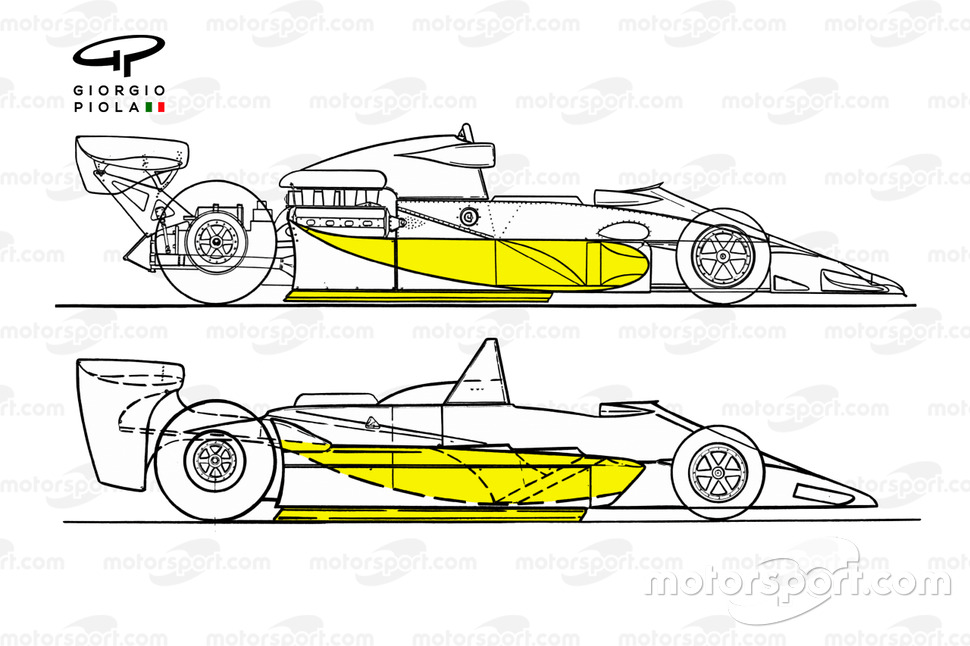
Venturi tunnel design and ground effect in the Lotus 79, one of the first single-seaters to successfully use ground-effect aerodynamics.
Source: Motorsport (2020).
From 1983 to 2021, wings dominated. In 1983, the FIA required a completely flat floor, which pushed wing development forward rapidly. From the 1980s to the 2000s, wings evolved from a simple stabilizing tool to a crucial part of making the car more effective. In the 1980s, wings were very large and basic; there was no rule limiting the wings of the car. Teams experimented with wings multiple times and in different ways. In the 1990s, wing evolution became extreme. Multiple wing elements were introduced on the front wing; side wings increased in size to block dirty air coming from the front tires. Rear wings became narrower, while the main planes were added to create a balance between top speed and grip in corners. During this period, the foundations of modern wings were established. In the 2000s, car aerodynamics continued developing, no longer as independent parts, but as a combined concept. Every centimeter of the car is designed in a specific way to be as efficient as possible. Engineers began simulating aerodynamic flow using computer programs, which allowed new parts of the car to be designed with greater precision regarding how they would behave. As this evolved, a new problem entered the scene: dirty air. Due to the complexity of the wings and the aerodynamic concept of the car, dirty air increased. At first it was a relatively harmless inconvenience, but as the cars changed, on-track battles became increasingly unfavorable for the chasing car. The FIA, seeing that this would lead to an extreme dependence on wings, returned to the concept of ground effect as an attempt to improve racing battles.
The FIA attempted to fix this issue with the 2022 regulations, where ground effect would return, this time regulated. This time, turbulent air was intended to be directed higher to reduce the impact on the chasing car. The concept of Venturi tunnels returned in a very similar way, but another issue appeared. Dependence on the floor became so great that the cars stuck to the ground, making airflow inconsistent or causing it to stop completely (aerodynamic stall), making the car rise again and repeat the cycle. This led to a phenomenon called porpoising, where the car “bounces” at high speeds. The FIA fixed this by raising the ride height of the car by a few millimeters and making the suspension stiffer. This gradually stopped porpoising, but dirty air returned. In the 2026 regulations, the FIA gave less importance to ground effect in favor of new alternatives such as active aerodynamics. Wings change angle to allow more airflow on straights and more resistance in corners.
Environmental Implications
Aerodynamics has environmental implications. Aerodynamic efficiency allows the same speed to be reached with less effort and less energy from the car. These concepts drive the development of new discoveries in the automotive industry that, over time, make their way into commercial cars. On the other hand, aerodynamic development in Formula 1 carries negative environmental implications. The development of these technologies involves high energy and material consumption. Energy is required for wind tunnels, the manufacturing of parts, and simulations, among other things. Formula 1 and the FIA have committed to becoming more environmentally conscious. In the 2026 regulations, a major improvement has been achieved. The most notable is the 50/50 power split between an internal combustion system and an electric one.
Economic Implications
The economy of Formula 1 has multiple layers. First, the development of single-seaters costs teams millions of dollars. From the manufacturing of parts to the wind tunnels where cars are tested. Every small improvement can provide tenths of a second, but can cost millions in development. These developments are carried out by many engineers working in different departments. This means that job creation in F1 is very diverse and broad. All these developments made by world-class engineers eventually reach the automotive industry. What teams learn, they develop and, over time, it reaches commercial cars. One very important example is the aerodynamic design of bodywork. Mercedes-Benz started developing the aerodynamics of its F1 car by introducing new parts and seeing how they behaved until it eventually reached its road cars. The Mercedes-Benz EQS was designed with these developments: a more rounded shape, curved roofs, a more aerodynamic floor, and optimized airflow. The car has an absurdly low aerodynamic coefficient (~0.20).
Implications for the Future of Humanity
Aerodynamics means more efficient vehicles; fuel consumption is optimized to get the most out of the car. Electric cars, with more range, lower energy consumption, and fewer polluting emissions, are only some examples of more sustainable transportation. Not only in cars, but also in high-speed trains, airplanes, trucks, and urban transportation, because they all fight against the same variable: air. Many bullet trains are designed with extreme aerodynamics. They are tested in aerodynamic simulation programs originally designed for Formula 1. These developments also point toward greater safety. Improving car grip, braking, and stability, reducing the risks of accidents or loss of control.
Bibliography
Formula 1. (n.d.). F1 explains downforce and why F1 cars have wings with McLaren Aero. Formula1.com. https://www.formula1.com/en/latest/article/f1-explains-downforce-and-why-f1-cars-have-wings-with-mclaren-aero.10xj8CJPz8s7CmwfoyWmCU
Mercedes-AMG Petronas Formula One Team. (n.d.). Downforce in Formula One explained. Mercedes-AMG Petronas Formula One Team. https://www.mercedesamgf1.com/news/feature-downforce-in-formula-one-explained
Xingal Engineering. (2017, September 2). Aerodynamics of Formula 1 car. WordPress. https://xingalengineering.wordpress.com/2017/09/02/aerodynamics-of-formula-1-car/
Carthrottle. (n.d.). Aerodynamics of Formula 1: Complete Guide. Car Throttle. https://www.carthrottle.com/post/w8mqx32
Motorsport.com. (2020, May 21). Lotus 79: The story of the car that revolutionized ground effect in F1. Motorsport.com. https://es.motorsport.com/f1/news/lotus-79-efecto-suelo-historia/4795034/
Formula1-Dictionary. (n.d.). F1 ground effect. Formula1-Dictionary. https://www.formula1-dictionary.net/f1-ground-effect/
Oracle Red Bull Racing. (n.d.). Guide to aerodynamics. Oracle Red Bull Racing. https://www.redbullracing.com/int-en/oracle-red-bull-racing-guide-to-aerodynamics
 F1 Engineering
Leave a comment